
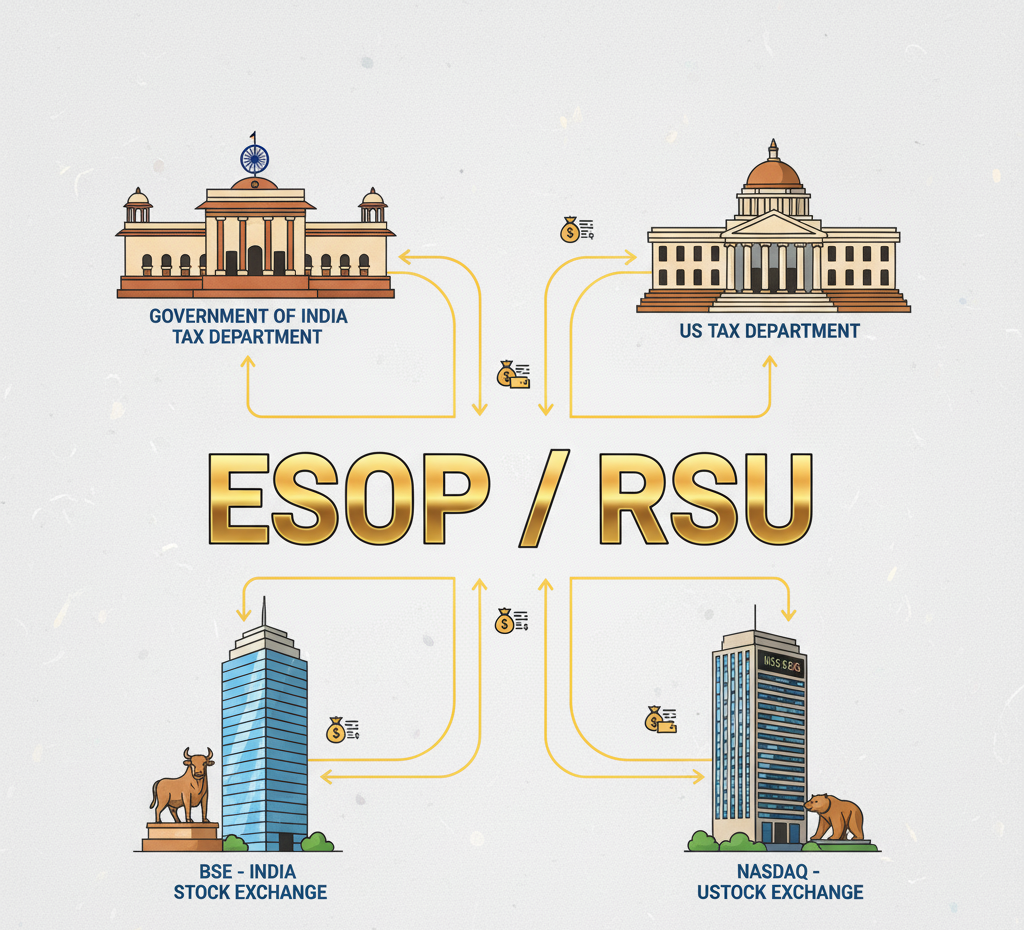
Rahul, a senior manager in Pune working with Amazon, received a mail: “Congrats! You’ve been granted ESOPs.”
It sounded like free money. But two years later, when he finally exercised his options, his salary slip showed a fat tax cut. His first thought: ‘Wait… wasn’t this supposed to be a bonus?
If you’ve got ESOPs or RSUs from your employer, here’s what you really need to know:
Step 1: Understand How They Work
ESOPs (Employee Stock Options): The company gives you the right to buy shares at a fixed price (exercise price). If the market price is higher, that’s your gain.
RSUs (Restricted Stock Units): You don’t buy them; shares are granted as they vest. But the catch is, they’re taxed as income the moment they vest.
Step 2: When You Exercise or Sell, Taxes Show Up
For ESOPs, tax shows up when you exercise.
For RSUs, tax shows up at vesting.
In both cases, the difference between the market price and your grant price is taxed as salary income in India.
Later, when you sell the shares, you also pay capital gains tax.
So yes—taxed twice, but at different stages.
Step 3: Cross-Border Twist (DTAA & Form 67)
Many Indian professionals working for U.S. companies face double taxation: once in the U.S., again in India.
The India–U.S. DTAA (Double Tax Avoidance Agreement) saves you. You can claim credit for U.S. taxes paid.
But here’s the catch: you must file Form 67 before your Indian return. Miss it, and you lose the credit.
Step 4: The Hidden U.S. Estate Tax Rule
Few people know this: if you hold U.S. company shares worth more than USD 60,000 at the time of death, the U.S. estate tax kicks in—even if you’ve lived in India all your life.
Confused about when to exercise, sell, or how to save on taxes? Let’s simplify it for you. Book a session with us today.